
November 7, 2026
Estimated Reading Time: ~4 minutes
Federal Budget 2026 Analysis — Program Streams, Eligibility Distinctions, and Planning Timelines
Three Key Takeaways
Be Mindful of Eligibility Boundaries: The headline $32+ billion for infrastructure and housing is tied strictly to First Nations on-reserve programs through Indigenous Services Canada. Inuit, Métis, and urban/off-reserve organizations must strategically target broader, distinctions-based streams such as the Indigenous Loan Guarantee Program, Build Canada Homes, and remote clean energy initiatives.
Expect a 6–18 Month Administrative Runway: Announcing funding in a federal budget does not mean money is immediately accessible. As shown by previous initiatives like Build Canada Homes, establishing portal infrastructure, intake criteria, and agreements takes several months; funds will not flow immediately.
Use the Rollout Window to Build Readiness: Rather than waiting for portals to open, leadership and economic development teams should use this period to prepare shovel-ready proposals, complete feasibility studies, and secure Council/Board resolutions so they can submit as soon as intakes launch.

Executive Overview
On November 5, 2026, the Government of Canada released its federal budget, Budget 2026: Masters of Our Destiny. While major headlines highlight tens of billions in long-term commitments toward infrastructure, clean energy, and economic equity, navigating these opportunities requires a clear understanding of:
Terminology and Eligibility: Where funding is restricted strictly to First Nations on-reserve vs. where streams exist for Inuit, Métis, and urban/off-reserve organizations.
Implementation Lag: Why major budget announcements require a 6- to 18-month administrative runway before community-level funding portals open.
Immediate Preparation: Actions communities and organizations can take now to ensure proposals are shovel-ready when intakes go live.
Budget 2026 enforces a strict Capital Budgeting Framework designed to balance day-to-day operating spending a year early (by 2027–28) while shifting borrowing capacity almost entirely toward tangible capital assets.
Critical Context: Navigating Eligibility & Policy Gaps
A central issue across federal budgets is the distinction between statutory, reserve-based commitments and broader, distinctions-based funding. When evaluating opportunities for your community or organization, keep the following distinctions in mind:
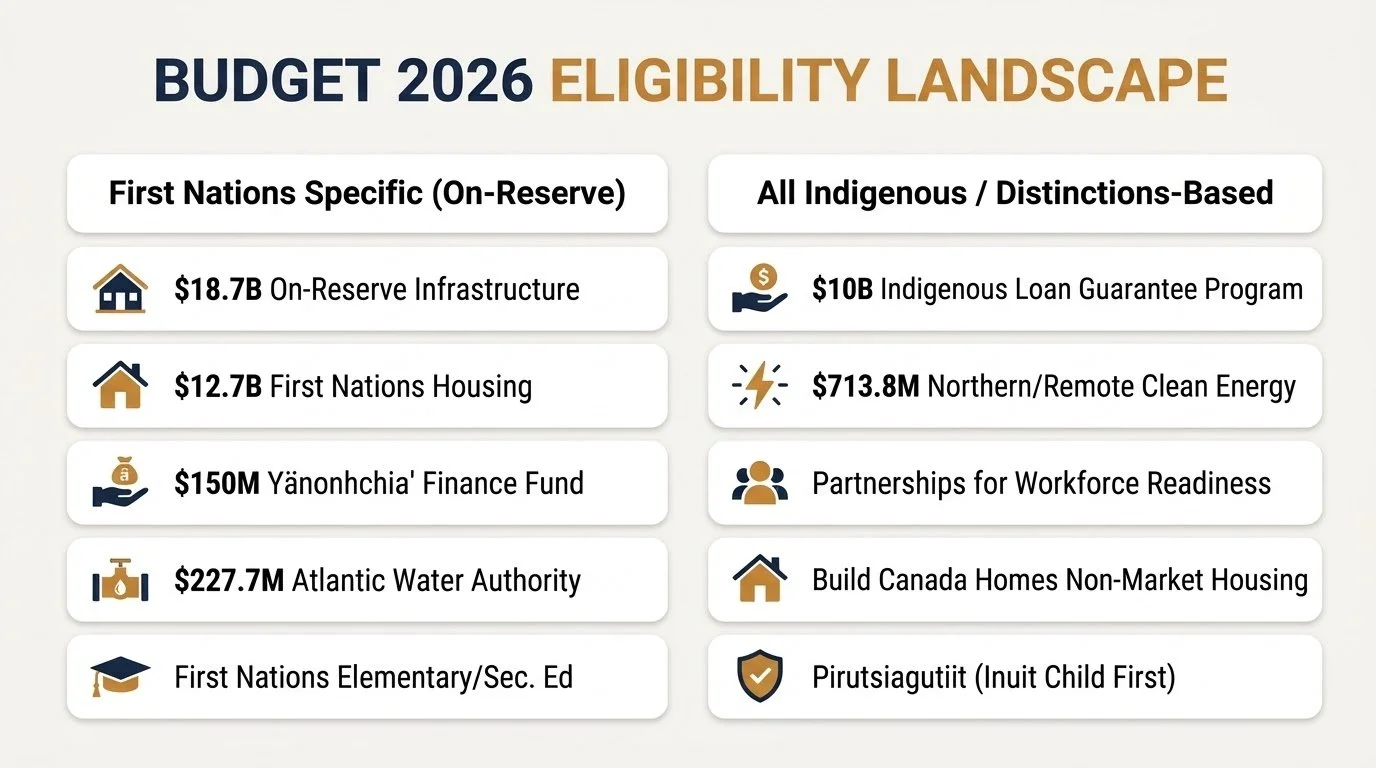
1. First Nations-Specific Commitments (Reserve-Bound)
The largest single allocation, $32+ billion over 10 years for housing and community infrastructure, is anchored under Indigenous Services Canada (ISC) federal-Crown fiduciary arrangements:
$18.7 Billion for Infrastructure: Directed to the First Nations On-Reserve Infrastructure Program (e.g., water, wastewater, community assets).
$12.7 Billion for Housing: Dedicated to stabilizing core on-reserve housing ($11B) and accelerating shovel-ready builds ($1.7B over 5 years).
$657.5 Million in Innovative Financing: Targets reserve housing delivery models, including the Yänonhchia' Revolving Housing Finance Fund ($150M) and an on-reserve Monetisation Pilot ($500M).
2. The Urgent Need for Broad & Distinctions-Based Funding
These on-reserve lines do not directly address the acute capital gaps facing Inuit Nunangat, Métis communities, or urban and off-reserve Indigenous organizations. For those groups, funding must be sought through alternative mechanisms:
Inuit Communities: Capital and social investments primarily flow through separate distinctions-based accords, territorial transfers, and targeted streams such as Pirutsiagutiit (the Inuit Child First Initiative).
Métis Settlements & Citizens: Infrastructure and social supports must be routed through the Canada-Métis Nation Accords, the Métis National Housing Strategy (perhaps making independent Métis communities access a barrier), or broader national programs.
Urban & Off-Reserve Populations: Over half of Indigenous people live off-reserve or in urban centres. These service organizations rely on broader non-reserve streams, primarily through Build Canada Homes, CMHC's Affordable Housing Fund, and municipal/provincial co-investments.
Open Cross-Distinction Streams: Programs such as the Indigenous Loan Guarantee Program (ILGP), the Clean Energy Transition Fund for Northern/Remote Communities, and the Partnerships for Indigenous Workforce Readiness Fund are designed with broader eligibility criteria that allow participation across First Nations, Inuit, and Métis proponents.
Managing Expectations: The Implementation Runway
When communicating these figures to community members, it is vital to manage expectations regarding when cash actually becomes available.
The Administrative Build-Out: When major agencies or programs are introduced, such as the federal Build Canada Homes agency (announced fall 2025 with rollouts continuing through 2026), it routinely takes several months to over a year to establish program criteria, staff intake teams, develop application portals, and execute contribution agreements.
10-Year Phased Horizons: Large headline numbers ($32B for infrastructure, $1.6B for northern power) are backloaded over multi-year horizons. Initial disbursements will focus on planning, engineering studies, and governance models rather than immediate full-scale construction checks.
Avoid Budget Assumptions: Do not budget for grant inflows. Instead, treat this period as an application preparation window.
Upcoming Grant & Program Opportunities (12–18 Month Outlook)
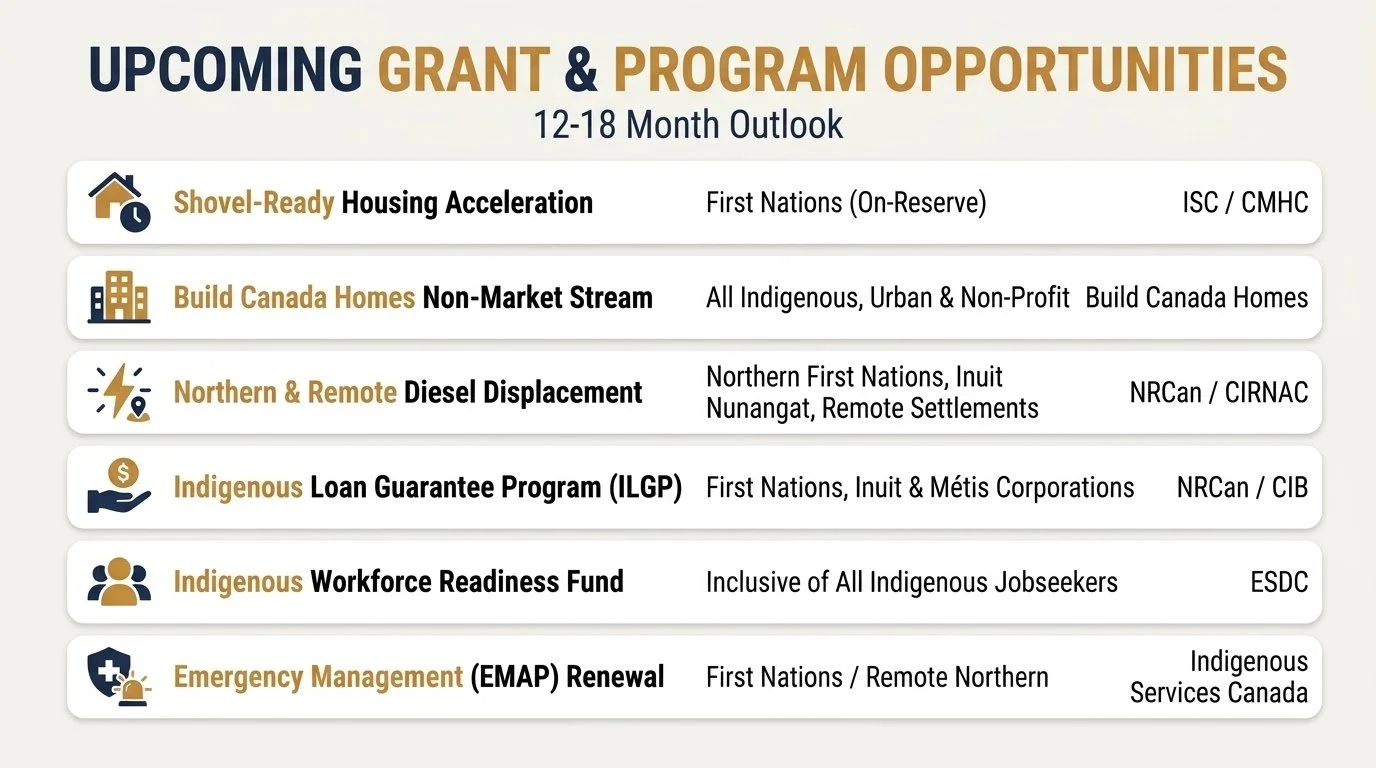
Actionable Next Steps for Leadership & Planners
Audit Project Readiness: For on-reserve housing and community assets, assemble shovel-ready engineering designs, cost estimates, and Council/Board resolutions now to prepare for early-round ISC intakes.
Explore Mainstream & Cross-Distinction Streams: If you represent Inuit, Métis, or urban Indigenous groups, prioritize tracking Build Canada Homes and NRCan Remote Clean Energy portals, where eligibility is not restricted to reserve land.
Engage Economic Development Entities: Evaluate opportunities under the $10B Indigenous Loan Guarantee Program if your traditional territory overlaps with major infrastructure corridors, mining, or clean power projects.
Build a Timeline Buffer: Ensure financial planners incorporate a 6- to 12-month processing runway between intake application and initial drawdowns to prevent local cash-flow shortfalls.
Key Social, Health, and Family Program Commitments
Social supports in Budget 2026 are primarily concentrated in Chapter 4.3 (Advancing Reconciliation with Indigenous Peoples, pp. 241–243):
Child and Family Well-Being:
Jordan’s Principle ($6.0 Billion over 6 years): Provides predictable funding to ensure First Nations children access medical, educational, and social supports without jurisdictional delays.
Pirutsiagutiit / Inuit Child First Initiative ($575 Million over 5 years): Distinctions-based equivalent providing identical social and health access for Inuit children.
Indigenous Child Welfare Implementation ($806 Million over 5 years): Supports communities exercising jurisdiction under the federal Indigenous child welfare legislation (former Bill C-92), helping transfer governance to First Nations, Inuit, and Métis child and family service models.
Health and Safety:
Non-Insured Health Benefits (NIHB) Program ($2.9 Billion over 3 years): Stabilizes operational funding for critical coverage of prescription drugs, dental care, vision, mental health counseling, and medical transportation for eligible First Nations and Inuit individuals.
Indigenous Community Public Health Workforce ($290 Million over 4 years): Renews funding for community-level public health workers, nursing stations, and preventative health initiatives.
First Nations and Inuit Policing Program (FNIPP): Multi-year renewal to support dedicated policing services and community safety agreements.
Education and Capacity:
First Nations Elementary and Secondary Education on Reserve: Funding stabilization to cover operating grants for on-reserve schools and tuition agreements.
Fiscal & Institutional Capacity of Indigenous Governments: Dedicated resources to help Band administrations, tribal councils, and self-governing bodies manage complex governance demands (p. 243).
What This Means for Community Clients
Service Continuity Over New Grants: For social service and health providers, Budget 2026 is largely about continuity and preventing shortfalls in core operations (NIHB, Jordan's Principle, child welfare) rather than launching a wave of competitive new grant application portals.
Target Capital/Transition Envelopes: If a community organization is looking for new, competitive grant intakes over the next 12 to 18 months, those are far more likely to appear in capital-adjacent programs such as shovel-ready housing, emergency preparedness (EMAP), clean energy, or workforce training tied to major infrastructure.
The Métis Operating Gap: Outside of the $806 million child welfare envelope, Métis communities and urban Indigenous non-profits continue to face an acute lack of dedicated operational health and social program lines compared to reserve-based First Nations, requiring them to pursue mainstream federal and provincial service contracts
Key Document References: Budget 2026 Cover Letter & Overview (pp. 4, 25, 48–49); Chapter 1: Clean Energy & Major Projects (pp. 125–126); Chapter 4: Advancing Reconciliation (pp. 236–244).