
Frequently Asked Questions
Finding the right fit
-
The right fit depends on your priorities, timelines, and internal capacity.
Some teams need ongoing coordination across multiple grants and reports, while others need focused help with one strong application or a clearer view of which opportunities are worth pursuing first.
The goal is to match the level of support to what will be most useful for your team. This makes it easier to move forward in a way that feels manageable, aligned, and realistic for your current capacity.
-
Ongoing support helps keep funding work moving across the year in a coordinated way. This work can include funding research, application writing, submission support, reporting assistance, timeline management, and regular communication so your team knows what is moving and what comes next.
The benefit is continuity. Instead of approaching each deadline in isolation, your team gains a more organized process, less last-minute pressure, and added capacity to keep multiple priorities moving at once.
-
Yes. Targeted grant writing support is available for one specific opportunity when your team needs added capacity, stronger writing support, or help meeting a tight deadline.
This option is often a good fit when the opportunity is important, time-sensitive, or too large to take on internally without stretching your team too thin.
The result is a stronger submission and less administrative burden on staff.
-
A Grant Research Report gives your team a clearer view of which opportunities are most aligned with your priorities, timing, and capacity.
It typically includes a tailored scan of relevant funding sources, a review of fit and eligibility, and a prioritized shortlist with key details to support decision-making.
The value is clarity. Instead of sorting through a long list of possibilities, your team gets a practical roadmap that helps focus effort where the fit is strongest.
How the process works
-
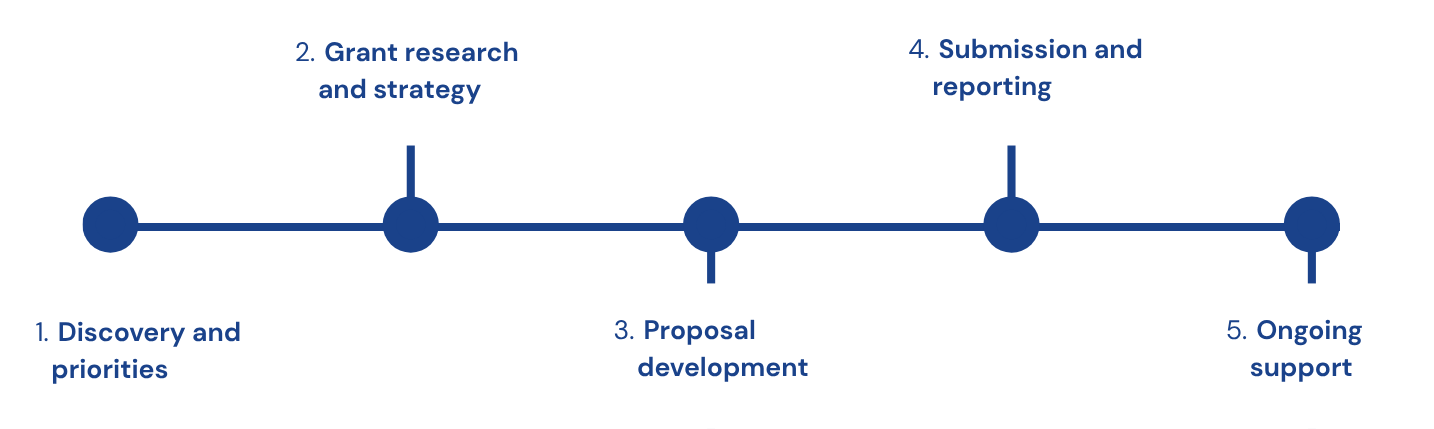
The process begins with a conversation about your priorities, timelines, and current capacity. From there, the work is scoped around what will be most useful, whether that is ongoing coordination, one focused application, or a funding research report.
Once priorities are clear, the process moves into information gathering, planning, drafting, review, and next steps. The goal is to keep the work organized, transparent, and manageable, so your team always knows what is happening and what is needed.
-
Your team’s role is to provide the key information, context, and direction needed to keep the work accurate and aligned with your priorities. This may include sharing background materials, confirming goals, reviewing drafts, and identifying any budget or technical details required for a submission or report.
The process is designed to reduce pressure, not create more of it. That means requests are kept focused and practical, with the aim of making the best use of your team’s time.
-
Yes. Support is shaped around your team’s priorities, deadlines, and available capacity.
Some clients need steady support across multiple streams of work. Others need help at a specific stage, such as identifying opportunities, developing an application, or managing reporting.
The process is designed to be practical and responsive, so the work fits your reality rather than adding more strain.
-
Your involvement depends on the type of support and the complexity of the work. In most cases, your team provides direction, confirms priorities, reviews key drafts, and shares any information needed to keep submissions accurate and grounded in your goals.
The intention is not to create more work for your team. It is to make the process more manageable by focusing your time where it matters most.
What this support makes easier

-
Yes. Grant reporting support can be included as part of ongoing grant writing and reporting support.
This helps reduce pressure after funding has been secured by keeping reporting requirements organized and on track. It also helps protect your team’s time and lowers the risk of deadlines being missed when capacity is already stretched.
-
Support can help move forward a wide range of priorities, depending on your goals and the funding landscape.
Focus areas may include areas such as health care, mental health, workforce development, transportation, education, infrastructure, housing, youth programming, and cultural initiatives
The focus is always on helping your team pursue opportunities that align with your priorities, rather than chasing funding that does not fit.
-
Ongoing support helps your team move from reactive grant writing to more coordinated funding planning.
Instead of scrambling when a deadline appears, opportunities can be tracked earlier, timelines can be managed more clearly, and writing and reporting can move forward with less disruption.
This approach often means less pressure on staff, better sequencing of priorities, and stronger continuity across the full funding cycle.
-
Yes. One of the main benefits is reducing the administrative pressure that can come with researching opportunities, coordinating deadlines, preparing applications, and keeping reports on track.
This work helps protect leadership and staff time so your team can stay focused on service delivery, operations, governance, and community priorities. That client-centred, burden-reducing approach is strongly reflected in your current profile and framework.
Relationship, approach, and trust
-
The work is grounded in partnership, respect, and the understanding that communities already know their priorities, leadership direction, and long-term goals.
The role of grant support is not to direct those priorities, but to help move them forward with less pressure, more clarity, and stronger coordination.
The approach is relational rather than transactional, and it is intended to build capacity over time rather than create dependency.
Language and communications are shaped to be respectful, plain, and community-centred, with care taken to use appropriate terminology such as First Nations, Métis, Inuit, and Indigenous in accurate and respectful ways
-
Both. Support can be provided directly to communities and organizations, and in some cases it can also be provided through partner organizations or affiliated groups when that structure is the better fit.
The most important consideration is that the work remains aligned with the community’s priorities, timelines, and decision-making.
The goal is always to ensure the process is clear, respectful, and workable for everyone involved.
-
The process begins with your goals, your direction, and your context.
Background materials, conversations, and review points are used to make sure the work reflects your priorities and the way your team wants to communicate them.
That means submissions and related materials are developed with your input, not apart from it. The goal is to strengthen your efforts, not replace your voice.
-
The approach is designed to support immediate funding needs while also strengthening long-term capacity where possible. That work can supporting the creation of clearer internal processes, improving coordination, and helping knowledge stay within your team over time.
This approach reflects your current positioning around being a strategic extension of the team and supporting long-term capacity, not dependency
Fees and transparency

-
Fees are based on the type of support, the scope of work, and the level of coordination required.
Costs are discussed up front so your team has clarity on what is included and what to expect.
This approach helps avoid surprises and makes it easier to choose the level of support that fits your needs and budget.
-
Yes. The scope of work is reviewed first so the level of support can be matched to your priorities, timelines, and capacity.
This makes it easier to have a clear conversation about what is most useful, what is realistic, and how the work can be structured in a way that fits.
-
Yes. Different types of support are available depending on what your team needs.
Some clients need continuity across multiple grants and reports, others need focused help with one application, and others need a clearer funding roadmap before deciding what to pursue.
This flexibility helps ensure the work is shaped around your situation rather than forcing a fixed model.
-
Axioma uses human-supervised AI tools in limited, internal ways to support quality, efficiency, and workflow coordination. This work may include helping organize information, improve internal processes, and assist with drafting or review workflows.
For clients, this means some internal steps may be completed more efficiently, which can help reduce administrative burden and keep work moving in a timely way. It does not replace human judgment, relationship-building, strategic thinking, or the care taken to understand your priorities, voice, and context.
All client-facing work is reviewed by a person before it is shared, and client materials are handled with care.